Home › Blog › Ava Ledger vs. Salesforce
Ava Ledger vs. Salesforce: Which Business Platform Is Better for Running Your Business in 2026-2027?

For decades, business software has largely worked the same way.
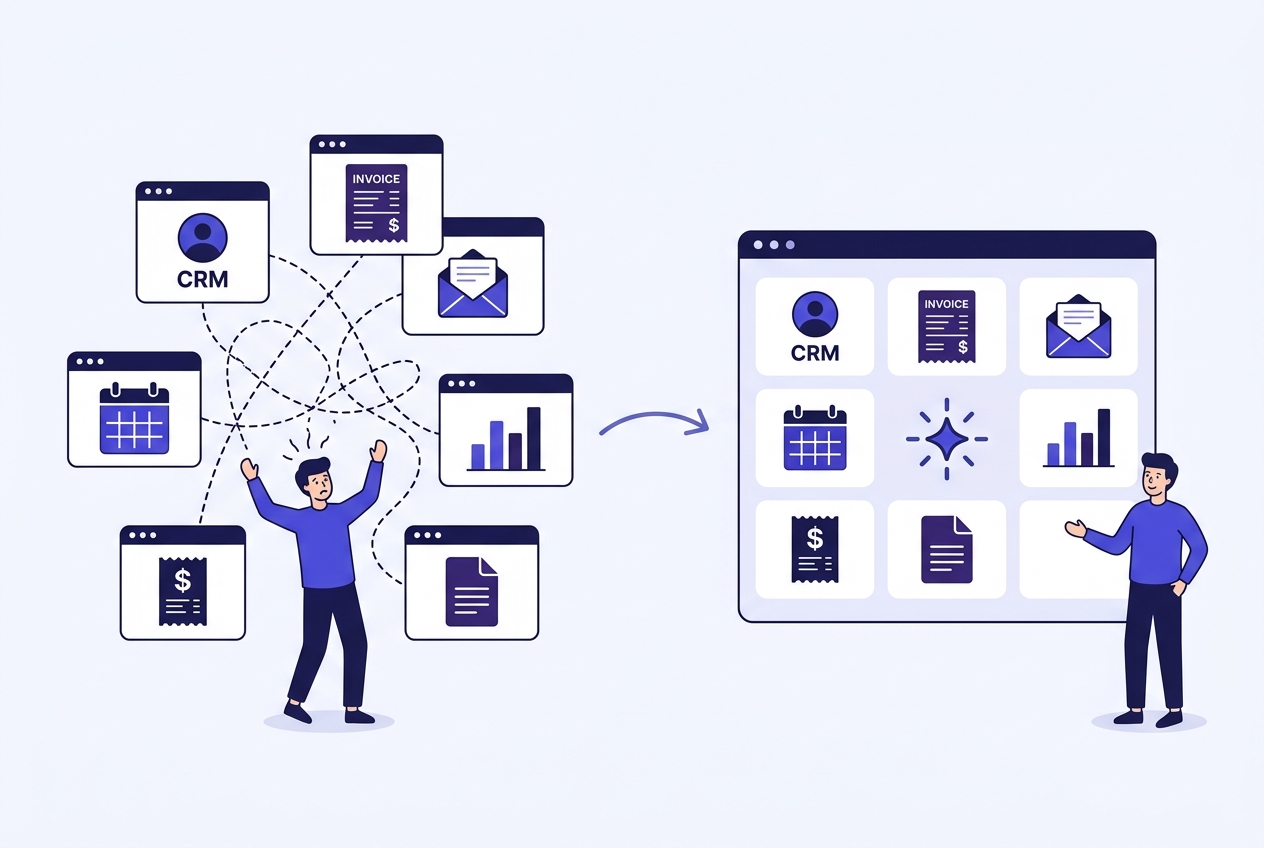
You buy a CRM to manage customers. Another platform handles accounting. Another sends invoices. Another manages email marketing. Another handles scheduling. Another tracks expenses. Another stores business documents. Another tracks mileage.
Then the business owner or employees become the system responsible for connecting everything.
Ava Ledger was built around a different idea: what if the software itself helped connect the business — and an intelligent assistant could help you actually run it?
That is why comparing Ava Ledger with Salesforce isn't simply a comparison between two CRMs.
Salesforce is one of the world's most established customer relationship management platforms. Ava Ledger is an all-in-one business management software platform built around Ava, an intelligent 24/7 business assistant designed to help businesses manage and complete everyday work from one connected environment.
And that difference becomes much larger once you look beyond the CRM.
What Is Salesforce?
Salesforce is a powerful CRM ecosystem built around managing customer relationships, sales, service, marketing, data, automation and increasingly AI-powered workflows.
Its enormous ecosystem, customization capabilities and enterprise infrastructure make it particularly powerful for organizations that need sophisticated sales processes, complex permissions, extensive integrations and highly customized workflows. Salesforce has also expanded heavily into AI through Agentforce and its broader AI ecosystem.
For organizations whose central requirement is deep CRM infrastructure and extensive customization, Salesforce remains an extremely capable platform.
But many businesses face a different problem. Their problem isn't simply managing customer relationships. Their problem is managing everything that happens around those customers and around the business itself.
That's where Ava Ledger takes a fundamentally different approach.
What Is Ava Ledger?
Ava Ledger is an all-in-one business management software platform designed to help businesses manage their day-to-day operations from one place.
Instead of requiring a business to assemble multiple disconnected applications, Ava Ledger brings core operational functions together within one connected system. That includes customer relationships and leads, email, invoicing, business finances, expenses, bookkeeping workflows, marketing, scheduling, documents, mileage, tax-related organization, financial reporting and other everyday business operations.
But simply putting more tools inside one application isn't the most important difference.
The real difference is Ava. Ava is the intelligent business assistant at the center of Ava Ledger. Ava isn't designed merely to answer questions about your business — Ava is designed to help you do the work.
That distinction changes what business software can feel like.
Ava Ledger vs. Salesforce at a Glance
| What you're comparing | Ava Ledger | Salesforce |
|---|---|---|
| Built for | Small & growing businesses that want one system | Enterprises with dedicated admins & developers |
| CRM & lead management | ✓ Included | ✓ Core product |
| Invoicing & payments | ✓ Included | Add-ons / third-party |
| Bookkeeping, expenses & financial reports | ✓ Included | ✗ Separate software |
| Email inbox & AI-drafted replies | ✓ Included | Via integrations |
| Email marketing | ✓ Included | Separate paid cloud |
| Scheduling & calendar | ✓ Included | Via integrations |
| Documents, estimates & proposals | ✓ Included | Add-ons / third-party |
| Mileage tracking | ✓ Included | ✗ Not offered |
| Intelligent assistant that helps do the work | ✓ Ava, 24/7, with your approval | Agentforce (enterprise-focused) |
| Setup & administration | Minutes — no admin required | Often consultants, admins & training |
| Pricing approach | Full Plan $18/mo for 3 months, then $69/mo; Invoice-Only $15/mo | Per-user, per-cloud; costs grow with add-ons |
Traditional Business Software Gives You Tools. Ava Helps You Use Them.
Think about what happens during an ordinary business day.
A potential customer emails you. Someone needs a follow-up. Another customer needs an invoice. An expense needs to be categorized. A receipt is missing. Tomorrow's appointments need attention. A lead hasn't received a response. A document needs to be created. A marketing message needs to go out. Your financial activity needs reviewing. Your accountant eventually needs organized information.
None of these tasks is individually extraordinary. The problem is that there can be dozens or hundreds of them.
Traditional software gives businesses places to perform those tasks. Ava Ledger is being built around something more ambitious: helping the business move those tasks forward.
Because Ava operates inside a connected business environment, she can assist with the information and workflows surrounding the work instead of existing as an isolated chatbot. Ava can help businesses respond to leads, draft customer communications, follow up, work with invoices, organize expenses, understand business activity, create documents and manage administrative work. Where an action should require human oversight, the user can approve it.
That creates a fundamentally different relationship between the person and the software. Instead of:
Open software → find information → determine what needs doing → navigate to another screen → perform the task
the experience increasingly becomes:
Tell Ava what needs to happen → review → approve → move on.

Imagine Your Business Actually Working as One System
This is where Ava Ledger becomes more than a collection of features.
Imagine a new customer contacts your business. In a fragmented software stack, that customer could touch five or six different systems. Their message lives in your inbox. Their contact information lives in your CRM. Their appointment lives in your calendar. Their estimate or invoice lives in invoicing software. Their payment becomes financial data somewhere else. Their follow-up may depend on you remembering to do it. Their future marketing communication could live in yet another application.
The business owner becomes the integration.
Ava Ledger is designed to remove as much of that fragmentation as possible. The customer relationship can remain connected to the work surrounding that customer. That means customer information isn't valuable only because it's stored — it's valuable because the rest of the business can work around it.
Ava Can Help Turn Your Inbox Into Business Activity
Email is where an enormous amount of business actually happens. New inquiries arrive there. Existing customers ask questions. Potential leads request information. Invoices are discussed. Appointments change. Opportunities appear. Problems appear.
Traditional CRM systems often require users to deliberately move information into the CRM. Ava Ledger approaches email as part of the operating environment. Incoming communication can be analyzed for business context and potential leads. Customer conversations can remain connected to customer information, and Ava can assist with drafting responses and follow-up.
Instead of an important opportunity becoming another unread email buried beneath tomorrow's messages, Ava can help turn communication into actionable business activity. And because the email side is connected with other parts of the business, the conversation doesn't necessarily have to end with an email — it could lead to the next business action.
That's the power of connected software.
CRM Becomes More Valuable When the Rest of the Business Is Connected to It
A CRM normally answers questions such as: Who is this customer? What stage is this lead in? When did we last contact them? What notes do we have?
Those are important questions. But a business often needs more. What did this customer ask for? What has already been discussed? Do I need to respond? Was an invoice created? What happened after the invoice? Do I have notes about this person? Is there another action that needs to happen?
Instead of treating the customer record as an isolated database entry, Ava Ledger's CRM is designed to create a more connected operational history around the relationship. That means the CRM isn't simply a database — it becomes part of the business's working memory.
Ava Ledger Connects Customer Management With Money
This is another area where the difference becomes significant. Customer activity and financial activity aren't separate in a real business.
A customer creates work. Work creates an invoice. An invoice creates revenue. Running the business creates expenses. Expenses create bookkeeping records. Those records eventually become financial reports and tax information.
Yet software often separates that chain into entirely different products.
Ava Ledger brings financial management into the same broader business environment. Businesses can monitor revenue and expenses, review financial activity, organize transactions, categorize expenses, track receipts and identify financial records that still need attention.
Instead of discovering at tax time that months of transactions haven't been organized properly, the goal is to make financial organization part of the everyday operation of the business.
Ava Ledger Doesn't Forget About the Accountant Either
Financial software shouldn't become a wall between a business owner and their accountant.
Ava Ledger includes a CPA-focused experience designed to give accounting professionals appropriate financial visibility without simply handing them unrestricted access to everything happening inside the business.
Financial information can be organized and prepared for review and export. Receipts can remain associated with financial activity. Uncategorized items can be surfaced. Businesses can work with cash or accrual views where appropriate. Financial reports and exports can help turn everyday activity into information that is actually useful when accounting and tax work needs to happen.
The objective isn't to replace professional accountants. It's to stop handing them a financial mess.
Ava Ledger Can Help With Invoices and Business Documents Too
An invoice isn't an isolated document. It belongs to a customer and a business relationship. The same is true of estimates, proposals, agreements and other business documents.
Ava Ledger's invoicing and document capabilities allow businesses to create professional business documents within the same broader environment where customer and operational information already exists.
That reduces another common source of fragmentation. Instead of repeatedly rebuilding the same customer and business information across disconnected applications, documents become another part of the connected workflow.
Marketing Doesn't Have to Live in Another Universe
A business's customer database can also become part of its future growth.
Ava Ledger includes email marketing capabilities that allow businesses to work with contacts gathered through their actual operations — including customers and leads — and organize those audiences for future communication.
That matters because marketing shouldn't necessarily begin with: export CSV → clean spreadsheet → import contacts → configure another application → reconnect the customer journey.
When marketing lives closer to the CRM and customer relationship, the business has a more continuous picture of the customer.
Calendar and Scheduling Become Part of the Same Operating Picture
The calendar is another place where business information often becomes isolated. A meeting might exist on the calendar without the broader customer context around it.
Ava Ledger brings scheduling and calendar activity into the business environment so that time, customers and operational work can exist closer together.
The important point isn't simply that Ava Ledger "has a calendar." There are thousands of calendars. The value comes from the calendar being part of the same system as the business.
Ava Can Help You Understand What Needs Attention
One of the biggest problems with modern business software isn't a lack of data. It's too much data.
Dashboards. Notifications. Emails. Transactions. Leads. Tasks. Calendar events. Customer records. Reports.
The business owner still has to determine: "What actually matters right now?"
Ava Ledger is designed to help with that problem as well. Through features such as daily business briefings, intelligent suggestions and contextual assistance, Ava can help surface activity requiring attention rather than forcing the user to continuously inspect every area of the platform.
And importantly, suggestions can remain subject to user approval. The objective isn't to take control away from the business owner. It's to reduce the amount of work required to stay in control.
Ava Can Learn How You Want Your Business Run
Every business operates differently. The same customer situation can require a different response depending on the company.
That's why Ava Ledger isn't designed around the idea that every user should behave identically. Users can teach Ava preferences and establish how they want assistance handled. Over time, the goal is for Ava to become more useful in the context of that specific business rather than behaving like a generic AI chatbot that starts from zero every time.
That's an important difference. A truly useful business assistant shouldn't only understand language. It should understand the business it is helping.
The Interface Matters Because Business Owners Aren't Software Administrators
Powerful business software often comes with a hidden cost: complexity.
More capability can mean more settings, more dashboards, more configuration, more training and more time learning how the software works.
Ava Ledger is approaching that problem differently. The user can still interact with the underlying business tools. But Ava provides another layer over those tools. Instead of always knowing which module contains the function you need, the goal is increasingly simple: tell Ava what needs to get done.
- "Draft a response to this customer."
- "Create an invoice."
- "Show me what needs attention."
- "Help me with these expenses."
- "Find this customer."
- "Prepare this document."
The software handles more of the complexity underneath. That's where an intelligent assistant becomes more than another feature. It becomes a new way of operating business software.
Ava Ledger vs. Salesforce: The Real Difference
Salesforce is extraordinarily powerful at what it was built to do. Ava Ledger isn't trying to become a smaller Salesforce. And that may be its biggest advantage.
Salesforce approaches the problem primarily from the world of customer relationship management and enterprise business systems. Ava Ledger approaches it from the everyday reality of operating a business.
The customer. The lead. The inbox. The invoice. The expense. The calendar. The document. The marketing. The financial activity. The follow-up. The administrative work. And the dozens of little things that have to happen between them.
Ava sits in the middle of that environment. That is a very different product philosophy.
Why Businesses End Up Paying for Multiple Software Products
Consider the typical software stack a growing business can accumulate: a CRM, accounting or bookkeeping software, invoicing, email marketing, scheduling, mileage tracking, document creation, automation tools, AI tools.
Each product might solve its individual problem extremely well. But every additional application introduces another subscription, login, interface, data source and workflow.
The financial cost matters. But the bigger hidden cost can be operational fragmentation. The owner has to remember where information lives. Employees have to learn multiple systems. Data has to move between applications. Integrations have to keep working. And someone still has to decide what happens next.
Ava Ledger's all-in-one approach isn't valuable merely because it can reduce the number of applications a business uses. The deeper value is what becomes possible when the information and the assistant live together.
Salesforce May Still Be the Better Choice for Some Companies
A fair comparison has to acknowledge this.
A large enterprise with sophisticated territory management, highly customized sales processes, extensive development requirements, complex organizational permissions and a large Salesforce ecosystem may have little reason to replace Salesforce with Ava Ledger. Salesforce has decades of enterprise development and an enormous ecosystem.
That isn't the battle Ava Ledger needs to fight.
The more interesting question is what happens below that level — among businesses that don't want their software stack to become another department they have to manage. For those businesses, simplicity combined with breadth and intelligent execution can be more valuable than unlimited customization.
So, Is Ava Ledger Better Than Salesforce?
It depends on what you're trying to accomplish.
If you need one of the world's deepest CRM ecosystems and extensive enterprise customization, Salesforce deserves serious consideration.
But if your problem sounds more like this — "I need help managing the business, not another piece of software I have to manage" — then Ava Ledger becomes a very different proposition.
Because Ava Ledger isn't simply asking businesses to replace one CRM with another. It's asking a bigger question:
What if your CRM, customers, communication, invoices, finances, expenses, marketing, scheduling, documents, reporting and everyday business operations could work together — with an intelligent assistant helping across them?
That's what Ava Ledger is building.
From Business Management Software to Business Execution
For years, the software industry competed over features. Who has the better CRM? Who has better accounting? Who has better invoicing? Who has better email marketing?
AI is creating another category of competition: who can actually help the business get the work done?
That's where Ava Ledger's vision becomes particularly interesting. The future of business software may not be another dashboard containing more information. It may be software that understands the information already inside the business, understands what needs attention and helps the people running the company take action.
Not another application demanding attention. Not another dashboard to monitor. Not another system that only tells you what happened.
An intelligent business assistant that helps you decide what happens next — and helps you do it.
That is the difference Ava Ledger is trying to create.
Ava Ledger: One Business. One Platform. One Intelligent Assistant.
Ava Ledger brings business management together around Ava — an intelligent 24/7 business assistant designed to help businesses manage everyday operations and move work forward.
Customers. Leads. Communication. Invoices. Finances. Expenses. Marketing. Scheduling. Documents. Reporting. And the work connecting all of it.
Instead of running your business around your software, Ava Ledger is being built so the software can help run around your business.
Try Ava Ledger free for 7 days
One platform. One intelligent assistant. Everything your business needs to run — connected.
Start My Free TrialNo credit card needed. Full Plan $18/month for your first 3 months, then $69/month. Cancel anytime.
Salesforce is a trademark of Salesforce, Inc. Ava Ledger is not affiliated with, sponsored by, or endorsed by Salesforce, Inc.