Home › Blog › Instacart Shopper Taxes 2026
Instacart Shopper Taxes 2026: The Complete Guide to What You Owe
Instacart doesn't withhold a cent of tax from your batch payments. Every dollar that hits your bank account is pre-tax income, and the IRS treats you as a self-employed business — not an employee. That's bad news if you find out in April, and genuinely good news if you understand it now, because business owners get deductions employees never see. Here's the complete 2026 picture for full-service shoppers.
You're a business of one — here's what that means
As an independent contractor, you report Instacart earnings on Schedule C attached to your personal return. Your taxable number isn't what Instacart paid you — it's your profit: earnings minus business expenses. Two taxes then apply. Income tax at your regular bracket, and self-employment tax at 15.3% (Social Security and Medicare — you pay both the employee and employer halves). The 15.3% is the one that ambushes new shoppers, because it applies from your very first dollar of profit, even if your income-tax bracket is low.
The paperwork: 1099-NEC, not a W-2
If you earned $600 or more, Instacart (via its payment processor) sends a 1099-NEC by late January reporting what you were paid. Three things to know. First, tips are taxable income even when they don't appear on the form — you must report all earnings, not just the 1099 number. Second, earning under $600 doesn't make the income tax-free; it just means no form is issued. Third, check the 1099 against your own records — payment processors make mistakes, and you're the one who signs the return.
The deduction that changes everything: mileage
For 2026, the standard mileage rate is 72.5 cents per business mile. Full-service shoppers drive constantly — to the store, between stores, to customers, back toward the zone for the next batch. A shopper logging 15,000 business miles deducts $10,875. At a combined 25–30% tax rate, that single deduction is worth roughly $2,700–$3,300 in real money.
Here's the trap: the Instacart app doesn't give you a complete, IRS-ready mileage log. It shows batch distances at best — not the drive to your first store, not repositioning between batches, not the return from a far drop-off. Those "invisible" miles are commonly 30–50% of the real total, a pattern we broke down in our delivery mileage guide (the mechanics are identical for Instacart). The IRS requires a contemporaneous log — date, miles, business purpose, recorded as you go. An automatic GPS mileage tracker builds that log in the background while you shop.
Every other write-off shoppers can claim
- Insulated bags and cooler equipment — the tools of full-service delivery.
- Phone and plan — the business-use percentage of your phone bill, plus mounts, chargers, and cables.
- Parking and tolls — paid while working batches.
- Car washes and cleaning — keeping your delivery vehicle presentable.
- Health insurance premiums — potentially deductible for self-employed shoppers who qualify.
- Accounting and tax software — tools that run your shopping business (including Ava Ledger).
- Roadside assistance memberships — protecting the vehicle your business runs on.
Keep the receipts — or better, sync the card you use for work so every expense is captured and categorized automatically with expense tracking. What you can't deduct: your own groceries, meals while shopping, traffic tickets, or everyday clothes.
Worked example: a real shopper's 2026 numbers
Say you earned $28,000 from Instacart (including tips) and drove 14,000 business miles. Mileage deduction: 14,000 × $0.725 = $10,150. Add $600 of phone, bags, and supplies. Profit: $28,000 − $10,750 = $17,250. Self-employment tax ≈ $2,437 (15.3% × 92.35% of profit). Income tax on top depends on your bracket and other income — but notice the deduction did the heavy lifting: without the mileage log, you'd be paying tax on $28,000 instead of $17,250. That's the difference between shoppers who track and shoppers who guess.
Quarterly taxes: when you pay matters too
If you expect to owe $1,000 or more for the year, the IRS wants estimated payments four times a year — mid-April, mid-June, mid-September, and mid-January. Skip them and an underpayment penalty stacks on top of the tax itself. The rule of thumb that keeps shoppers safe: set aside 25–30% of profit (not gross) every week, park it in a separate account, and pay each quarter from there. Our quarterly tax guide for 1099 contractors walks through the math and the safe-harbor rules in detail.
Multi-apping? One record or chaos
Most shoppers also run DoorDash, Uber Eats, or Shipt. Each platform sends its own 1099 and tracks nothing useful for taxes across apps. The fix is structural: one mileage log, one expense record, one income view across every platform, assembling into a single Schedule C. That's exactly the setup on our multi-app gig worker page — and if DoorDash is your other app, the DoorDash tax guide covers its quirks.
The one-evening setup that fixes tax season
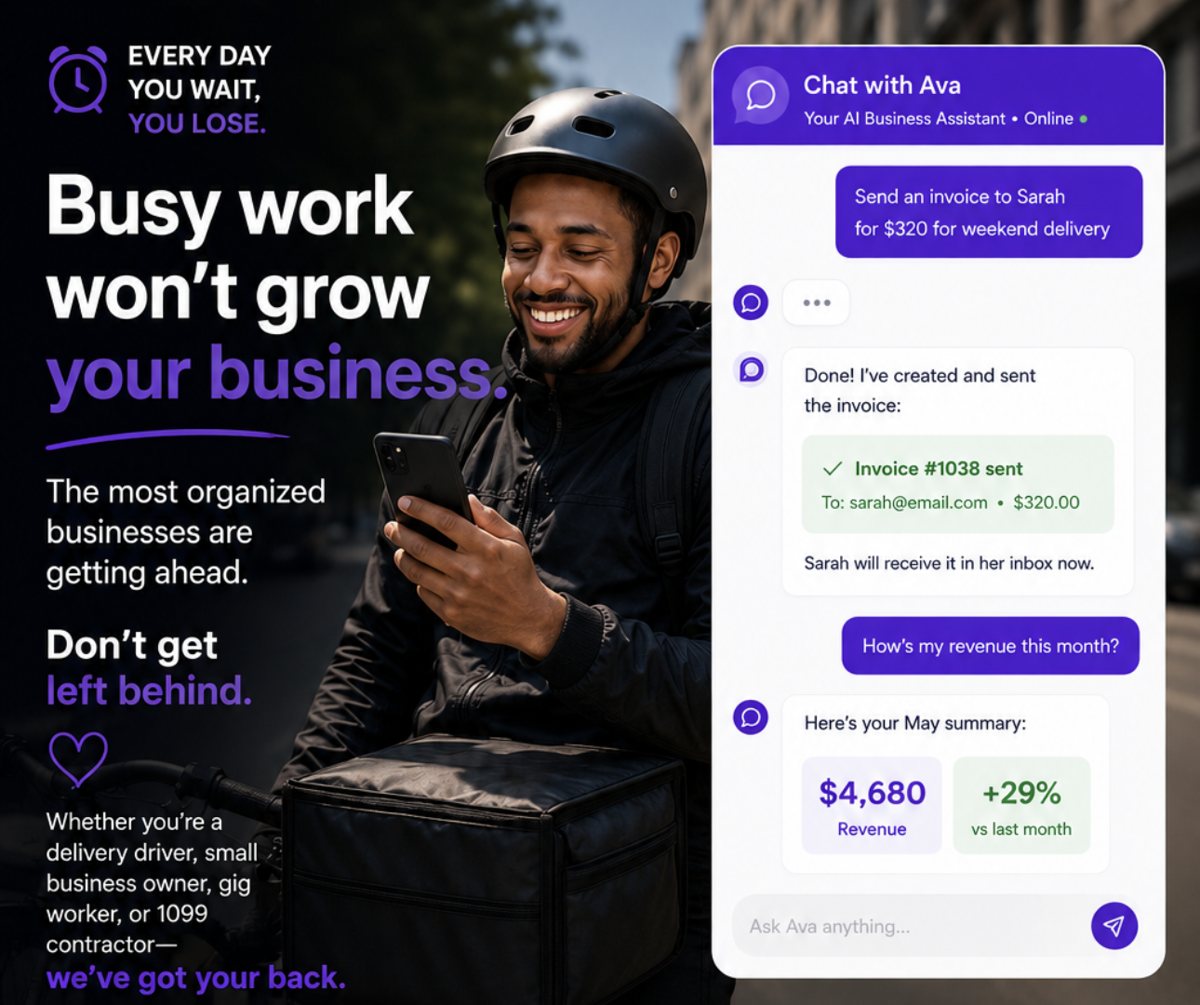
Everything above is a records problem before it's a tax problem. Tonight, in about twenty minutes: turn on automatic mileage tracking, connect the bank account your Instacart deposits hit, and set reminders for the four quarterly dates. From then on, every batch you run documents itself — live profit, a growing mileage log, categorized expenses, and a running estimate of what to set aside. Ava Ledger's Instacart shopper setup does all of it automatically, and come January your Schedule C is a report you read, not a shoebox you reconstruct. Seven days free.
This article is general information, not tax advice. Rules have exceptions; confirm your specific situation with a tax professional.